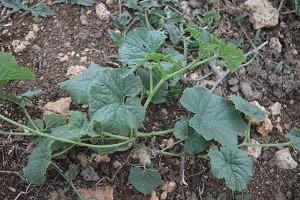
Squash (Engl.)
Cucurbita moschata (Duchesne. ex Lam.) Duchesne. ex Poir.
AntisepticAn annual climbing plant Height: Up to 5 metres long Leaves: Leaves alternate, simple, without stipules; petiole 9–24 cm long, grooved; blade broadly ovate in outline, shallowly palmately 5–7-lobed, (10–)20–35 cm in diameter, deeply cordate at base, margins toothed, softly hairy, sometimes with white markings disappearing at senescence, 3-veined from the base. Flowers: Flowers solitary, unisexual, regular, 5-merous, large, 10–20 cm in diameter, lemon yellow to deep orange; sepals free, subulate to linear, 1–3 cm long; corolla campanulate, with widely spreading lobes; male flowers long-pedicelled (up to 16 cm), with 3 stamens, filaments free, anthers usually connivent into a long twisted body; female flowers shortly pedicelled (up to 3.5 cm), with inferior, ellipsoid, 1-celled ovary, style thick, stigmas 3, 2-lobed. Fruits: Fruit a large, globose to ovoid or cylindrical berry, weighing up to 10 kg, with a wide range of colours, often covered with green spots and grey stripes, with small, raised, wartlike spots; flesh yellow to orange, many-seeded; fruit stalk enlarged at apex.
Medicinal Uses & Benefits
Bun-i (infections of the skin or nails caused by fungi), Kagid (scabies) at Nuka-nuka (sores). Preparation: Collect enough number of leaves, pound and squeeze out the juice.. Part used: Leaves
Preparation
Collect enough number of leaves, pound and squeeze out the juice.
Location & Habitat
Research
Additional Images


Quick Info
- Scientific Name
- Cucurbita moschata (Duchesne. ex Lam.) Duchesne. ex Poir.
- Local Name
- Squash (Engl.)
- Family
- Rosaceae
- Category
- Antiseptic
- Collected By
- Jovencio M. Manga (healer); Cesario P. Orong (mangalalap); Edwin D. Castillon (mangalalap)
- Date Collected
- Jul 13, 2018