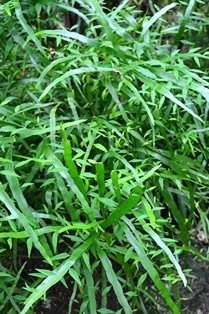
Centipede plant (Engl.)
Muehlenbeckia platyclada Meissn.
AntisepticA prostate shrub Height: Grows 1-5 meters and is heavily branched. Leaves: Leaves are dark green, elongated, flattened, alternately arranged on a flat stem. The leaves are simple, alternate, lanceolate, 0.5 to 2 cm. wide and 2 to 5 cm. long. Leaves are sessile, membranous, entire, often lobed at base, 1.5-6.5 cm long. Flowers: The unisexual cluster of flowers with greenish white perianths are borne in the axils. Flowers 1-6 in sessile clusters, bracteate, bracts ovate, c. 1 mm long. Perianth segments 5, greenish, oblong, 1-1.5 mm long. Stamens 8. Ovary ovoid, 3-angular c. 1 mm long; styles 3. Nuts enclosed in the fleshy deep red or purplish perianth. Fruits: The fruits are somewhat round in shape are classified as berries and turn red when ripe.
Medicinal Uses & Benefits
Samad (wound). Preparation: Pound enough amount of himag leaves and squeeze out the juice.. Part used: Leaves
Preparation
Pound enough amount of himag leaves and squeeze out the juice.
Location & Habitat
Research
Additional Images


Quick Info
- Scientific Name
- Muehlenbeckia platyclada Meissn.
- Local Name
- Centipede plant (Engl.)
- Family
- Polygonaceae
- Category
- Antiseptic
- Collected By
- Not provided
- Date Collected
- Jun 28, 2026