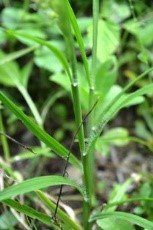
Burgrass (Engl.)
Cenchrus echinatus L.
SkinA mostly upright (i.e. erect or ascending) and loosely tufted short-lived (i.e. annual) grass Height: Up to 1 m in height Leaves: The leaves consist of a sheath, which partially encloses the stem, and a spreading leaf blade. The leaf sheaths are usually hairless (i.e. glabrous), but occasionally have a few hairs, while the leaf blades usually have some hairs present, particularly along their margins. The leaf blades (5-25 cm long and 3-12 mm wide) are very elongated (i.e. linear) and gradually narrow to a pointed tip (i.e. acute apex). Where the leaf sheath meets the leaf blade there is a small structure (i.e. ligule) that consists of a tiny membrane (0.5-2 mm long) topped with a dense line of hairs (i.e. the ligule is a ciliated membrane). The leaf sheaths, especially those on younger plants, and lower stems often have a reddish or purplish-coloured tinge (particularly when growing in a sunny position). Flowers: The seed-head (i.e. inflorescence) is spike-like (i.e. spiciform), but is actually a reduced panicle (3-10 cm long and 1-1.3 cm wide). This seed-head consists of several to many (i.e. 5-50), stalkless (i.e. sessile) or almost stalkless (i.e. sub-sessile), burr-like structures (4-10 mm across), each bearing many sharp rigid spines (2-5 mm long) and also some hairy bristles or flexible spines. These 'burrs' contain a cluster of two to four flower spikelets, and each flower spikelet usually produces a single seed. The flower spikelets (4-7 mm long and 1-2 mm wide) are narrowly egg-shaped in outline (i.e. ovate) with pointed tips (i.e. acuminate apices). They consist of a pair of glumes (i.e. 1.3-5.7 mm long) and a pair of tiny flowers (i.e. florets). The lower floret is usually sterile or occasionally male, while the upper one has both male and female parts (i.e. it is bisexual). Each floret has two bracts (i.e. a palea and a lemma), the male ones have three stamens, and the bisexual ones also have an ovary topped with two feathery stigmas. Flowering occurs mostly during summer and autumn.
Medicinal Uses & Benefits
Tooth grown in infant. Preparation: Wash and boil the whole part and spike of each plant for 5 minutes.. Part used: Whole plant
Preparation
Wash and boil the whole part and spike of each plant for 5 minutes.
Location & Habitat
Research
Additional Images


Quick Info
- Scientific Name
- Cenchrus echinatus L.
- Local Name
- Burgrass (Engl.)
- Family
- Poaceae
- Category
- Skin
- Collected By
- Not provided
- Date Collected
- Jun 28, 2026