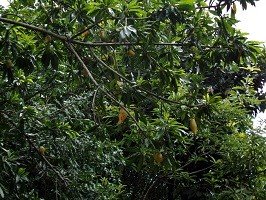
Tiesa (Tag.)
Pouteria campechiana Kunth (Baehni)
SkinAn evergreen tree with a slender or spreading crown. Height: It grows not more than 8 meters tall Leaves: Leaves evergreen. Alternate, though mostly grouped at branch tips, leaves are thin, glossy and petiolate. Leaf shape ranges from oblanceolate, lanceolate-oblong to obovate. Leaf apices are bluntly pointed while leaf bases are sharply tapered. Flowers: Flowers bisexual, solitary or in small clusters and fragrant. Borne at leaf axils or leafless nodes, the flowers are 5- or 6-lobed, cream-coloured, silky-hairy and about 8-11 mm long. Fruits: Fruits variable in shape, from nearly round to somewhat ovoid, oval or spindle-shaped, with or without a pointed apex or curved beak. Often bulged on one side, the fruit has a 5-point calyx at the base, which may be rounded or have a distinct depression. Size about 7.5-12.5 cm long and 5-7.5 cm wide.
Medicinal Uses & Benefits
Apoy-apoy (red, swollen spots) at Skin diseases. Preparation: Scrape the bark, wrap it with banana leaf and heat over live coal for 3 minutes.. Part used: Bark
Preparation
Scrape the bark, wrap it with banana leaf and heat over live coal for 3 minutes.
Location & Habitat
Research
Additional Images


Quick Info
- Scientific Name
- Pouteria campechiana Kunth (Baehni)
- Local Name
- Tiesa (Tag.)
- Family
- Sapotaceae
- Category
- Skin
- Collected By
- Jovencio M. Manga (healer); Cesario P. Orong (mangalalap); Edwin D. Castillon (mangalalap)
- Date Collected
- Oct 19, 2018