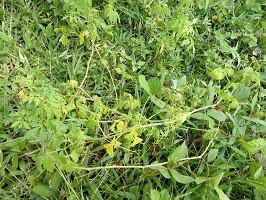
Balloon plant (Engl.)
Cardiospermum halicacabum L.
SkinPerennial herbaceous vine Height: Climbing with tendrils up to 3 meters on support. Leaves: Leaves alternate, biternately compound, triangular in outline, papery-thin with serrate margins, lateral leaflets smaller than terminal leaflet. Flowers: Species is monoecious, with male and female flowers found on same plant. Flowers milky-white, small and inconspicuous, produced in axillary racemes with terminal tendrils. Fruits: Showy inflated dehiscent capsules, around 2.5cm across, 3-loculed, papery, pubescent and non-fleshy (unlike most other members of Sapindaceae family), maturing from chartreuse-green to brown, containing 3 seeds each, dispersed by wind and water.
Medicinal Uses & Benefits
Nanghupong (swelling) at Hubag (boils). Preparation: Collect enough number of leaves of each plant and wash thoroughly. Wrap the leaves with a banana leaf and heat over live coal for 3 minutes.. Part used: Leaves
Preparation
Collect enough number of leaves of each plant and wash thoroughly. Wrap the leaves with a banana leaf and heat over live coal for 3 minutes.
Location & Habitat
Research
Additional Images


Quick Info
- Scientific Name
- Cardiospermum halicacabum L.
- Local Name
- Balloon plant (Engl.)
- Family
- Sapindaceae
- Category
- Skin
- Collected By
- Jovencio M. Manga (healer); Cesario P. Orong (mangalalap); Edwin D. Castillon (mangalalap)
- Date Collected
- Oct 19, 2018