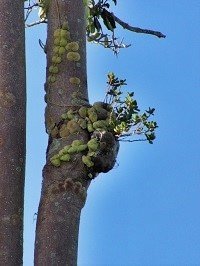
Ant plant (Engl.)
Hydnophytum formicarum Jack.
SkinIt is an epiphytic shrub with a tuber at its base. Its fleshy tuber is irregularly lobed, brown. Height: 15–20 cm across, tunneled, and perforated where ants would reside. Leaves: Leaves are opposite, thick, elliptic-obovate, 4 to 10 centimeters long, rounded or very bluntly pointed at the tip, and wedged-shaped at the base. Flowers: Flowers are solitary or few fascicled, borne in the leaf axils, pale white, about 6 millimeters long. Corolla is salver-shaped, about 5 millimeters long, cylindric, with four tufts of hairs in the throat. Fruits: Fruit is juicy, yellowish-red when ripe, broadly ovoid, and about 5 centimeters long.
Medicinal Uses & Benefits
Antidote for any types of cancers, tumor, goiter. Preparation: Chop the whole plant into small pieces. Expose it into the sun to make it dry. Boil in 1 liter of water for 10 minutes.. Part used: Whole part of the plant, fleshy part
Preparation
Chop the whole plant into small pieces. Expose it into the sun to make it dry. Boil in 1 liter of water for 10 minutes.
Location & Habitat
Research
Additional Images


Quick Info
- Scientific Name
- Hydnophytum formicarum Jack.
- Local Name
- Ant plant (Engl.)
- Family
- Rubiaceae
- Category
- Skin
- Collected By
- Jovencio M. Manga (healer); Cesario P. Orong (mangalalap); Edwin D. Castillon (mangalalap)
- Date Collected
- Nov 15, 2018